Featured Member: David Fobes
David Fobes entered the world in 1953 with his identical twin Clark. Being an identical twin has informed much of his work in the last 40 years. David was fortunate to study furniture design with AOD recipient Wendy Maruyama from 1991 – 1994 at SDSU.
He joined the faculty in the School of Art and Design at San Diego State in 1994 and taught studio courses in Design until his retirement in 2020. He has been an active member of the San Diego Arts community since 1981 and has exhibited his work regionally, nationally and internationally and has also curated a broad variety of projects throughout his career. His work is in both private and public collections.
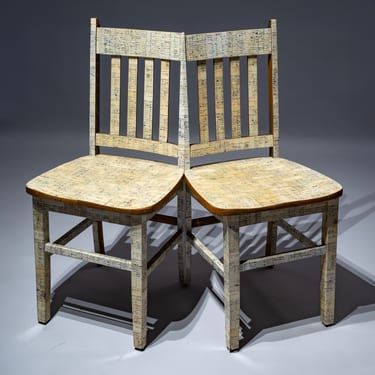
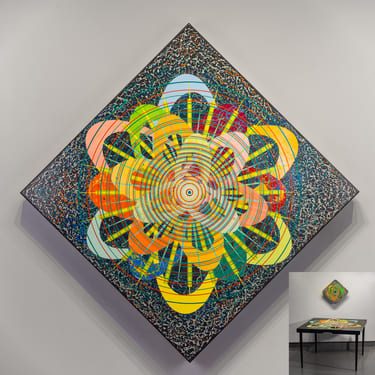
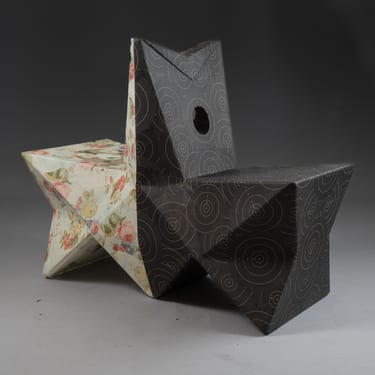
We caught up with David to hear more about his background and interests within the furniture field.
Tell us a little about yourself — where you’re based and how you got started making furniture.
I have lived in San Diego, California, since 1975, when I transferred to San Diego State
University to study Environmental Design with the visionary architect Eugene Ray.
My fascination with woodworking began around age six, helping my father, an amateur
woodworker, with his home furniture projects. By twelve or thirteen, my brother and I were using his Craftsman radial-arm saw to build our own odd projects. By the time I reached San Diego State, I had a practical familiarity with tools, materials, and making.
As an elective, I took a furniture class with Larry Hunter, who was then becoming known for his distinctive bent and stack-laminated functional objects. One of Larry’s guest speakers was sculptor Michael Jean Cooper. I was floored by his skill and imagination, and his work expanded my understanding of what furniture and woodworking could be.
In 1978, Eugene Ray hired several students, including me, to build his studio and home in La Jolla, “The Silver Ship,” from the ground up. The project was transformative, giving me the opportunity to work directly with an architect whose ideas challenged conventional approaches to design and construction. I subsequently worked as a craftsman and builder for a variety of creative local architects.
In 1983, I established a work-live studio in downtown San Diego, before the Gaslamp
redevelopment, when rents were cheap. I began making furniture prototypes in earnest while taking commissions. In 1985, I had my first solo exhibition at Patty Aande Gallery. The exhibition generated the X‑Cases, which were subsequently included in the Newport Harbor Art Museum’s “Future Furniture” exhibition.
In 1991, after producing a substantial body of work, I enrolled in the SDSU Graduate Furniture program, led by Wendy Maruyama. Her emphasis was not so much on how to make, but on what to make and why. Wendy introduced her students to makers, galleries, and exhibition opportunities. I remain great friends with her and am forever thankful for her unique influence on my journey as a maker.
What inspired your latest body of work? And who are some of your inspirations for furniture making?
“Inspiration is for amateurs. The rest of us just show up and get to work.” — Chuck
Close
It is a rather flippant answer to the question, but I think the sentiment is right. If you wait for inspiration, you may never get to work. I have always believed that “work makes work.” At this point in my career, I have far more ideas than I could possibly finish in my lifetime. The challenge is simply to get into the studio and be productive every day. Making something often leads to the next idea; the work itself becomes a form of research.
I have many art heroes, and they are not limited to furniture makers. I have always been interested in artists and makers who approach materials, form, and ideas in unconventional ways. Some have had a direct influence on my thinking, while others simply remind me of the possibilities of making.
Among the makers and designers I return to are Wendy Maruyama, Tom Loeser, Michael Hurwitz, Roseanne Sommerson, Ed Zucca, Michael Jean Cooper, Roy McMakin, Jim Isermann, Charlotte Perriand, Carlo Mollino, Frank Gehry, and Martin Puryear. My current painting heroes include Lari Pittman, Bridget Riley, Mark Bradford, Jeffrey
Gibson, and Jack Whitten.
What does being a member of the furniture community, and specifically The Furniture Society, mean to you?
I was an early member of FS, attending and presenting at FS98, FS01, and FS02, and later serving as a co-organizer for FS05 in San Diego with Steffanie Dotson and Katherine Ortega.
In those early days, before social media, the conferences provided a rare opportunity to meet some of the stars of the Studio Furniture movement and, equally important, to connect with other like-minded artists and makers. At FS01 at Arizona State University, I had the chance to have breakfast with Sam Maloof. I was completely star-struck, but we had a brief and sincere conversation that I still remember. It was just one memorable moment among many.
Although I have not been as active in FS in recent years, the FS website continues to be a valuable resource for me. I enjoy discovering makers who are new to me and learning about their individual journeys through making. In many ways, that spirit of connecting people through their work remains what I value most about FS.
Tell us about your preferred way of connecting with clients and customers. Do you sell online, attend shows, fairs, or markets, or primarily accept custom work?
My website, misterfobes.com, does generate some traffic, but I also use an excellent platform called Artwork Archive, which has become the archive and database for most of my work. I can create specific “rooms” of work and send them to clients, museums, and galleries when they are considering my work. It is far more effective than sending JPEGs, and certainly light-years removed from sending out 35mm slides — remember slides?
I have not been particularly successful selling work online. Most sales still come through galleries or word of mouth. I do take on commissions, but only when I feel the project aligns with my design vision and the clients are willing to take some risks.
I have never been interested in craft shows. I have nothing against them; they’re simply not my thing. My work has always existed somewhere between art, craft, design, and architecture, and I have generally preferred to let the work find its audience through exhibitions, galleries, commissions, and personal connections.
Do you have a specific joinery technique, favorite tool, or favorite wood that you like to use? Why is it your favorite?
My project materials can range from wood, cardboard, aluminum, acrylic, plywood, and paper to paint. Each project requires its own variety of tools and techniques, so it would be difficult to name a favorite. For wood projects, I try to use hardwoods that aren’t in especially high demand. Right now, cherry and maple seem to be good choices. Both are relatively stable, workable, and economical.
I prefer simple, structurally sound joinery — open mortise-and-tenon and traditional mortise-and-tenon joints. I also use a Festool Domino cutter to make floating mortise-and-tenon joints. Most of my furniture is painted, so the joinery needs to be sound, straightforward, and workmanlike rather than decorative. I’m usually chomping at the bit to get through the construction and arrive at the painted surface. That’s where the piece really begins to come alive for me.
Check out David’s profile page and website.