TFS Member Alf Sharp in Guatemala
Alf and his shop assistant spend time in the mountains of Guatemala to help build a Kingdom Hall of Jehovah’s Witnesses.
I was invited to help build a Kingdom Hall of Jehovah’s Witnesses in the mountains of Guatemala. I took along my good friend and shop assistant, Tom. We’re both well over six feet tall, and the diminutive natives of the area called us “los dos gigantes (the two giants)”. After a week there, I flew my wife down for the remaining two weeks of our tenure. We were working in the mountain town of Huehuetenago, a harrowing three hour bus ride from the capital, Guatemala City. Once on the torturous mountain road our bus was behind a slow-moving concrete truck. On one side of the road was a vertical cliff going up, and on the other a straight drop for several hundred feet. The bus driver pulled out to pass on one of the many blind curves. As we drew alongside the truck, around the curve from the opposite direction barreled a gasoline truck. I prepared to die. Somehow all three commercial sized vehicles managed to pass one another along this normally two lane road without touching. I guess it’s not without reason that many of the brightly painted buses in Central America include the phrase, in large letters, “Dios con Nosotros (God be with us)”.
Safely in Huehuetenango, we got down to work. We were staying with a Witness family who lived about three miles from the work site. Among a congregation of about 120 people, there were only two automobiles. The brother who owned one of them would normally pick us up in the morning to take us to the project. In the US, his car, which we dubbed “el carro”, would have long been relegated to the junk yard. It smoked like a locomotive. He kept a couple of extra sets of spark plugs, cleaned and gapped, on his dashboard, to be exchanged as the previous set became hopelessly fouled during each day’s driving around. He’d turn off the engine to save gas at every conceivable opportunity, and the engine had so little compression that he could bump start it with the clutch coming off any of the numerous speed bumps around town.
In the evening we’d generally walk back to our lodgings which was very pleasant. Lunch and dinner was served on site – great simple regional food that tasted quite exotic to us — so it would usually be rather late – 8:30 or 9:00 – because the custom was to take a 2 – 2 ½ hour siesta in the middle of the day, a most civilized custom. We’d lie in the grass on a little mound underneath a purple-flowering jacaranda tree and take a little nap. The younger, more energetic brothers would pick up a soccer game down the hill. I joined them once, but once was enough.
Because of moisture and termite issues, buildings in Central America are almost universally made of masonry. Doors and windows and interior trim are the province of woodworkers, hence our presence. We were working with green mahogany straight from the forest. Kiln drying is expensive and rarely used for local purposes. Significant cracks in the woodwork is a common feature of Central American buildings, we found. But mahogany moves much less than other woods, so the problem wasn’t insurmountable.
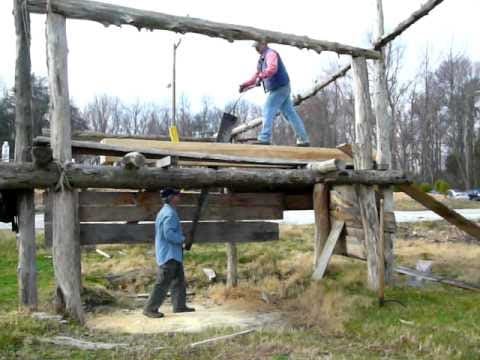
Modern woodworking machines were barely employed in this remote corner of a third world country. The lumber came to the worksite in the form of logs, and was rendered into planks by a version of pit sawing. The log was lifted onto a scaffolding about seven feet in the air. One brother would climb atop the log, the other would work below, the two of them wielding a long two-man saw. They would launch into the log early in the morning, and by evening they would have sawn three to five boards up to 15” wide and 12’ long. The quality of work was about what you’d expect – a thickness difference of maybe ½” from end to end, and prominent saw marks throughout.
Once inside, a board would be cross-cut into two or three pieces, and several brothers with jointer planes that had seen better days would begin addressing the planks. The planes were set to take a thin shaving, and they passed the planes along the boards as if they were playing shuffle board – almost pitching the planes forward. Very little, if any, wood was taken in a pass, but the motion was very rhythmic and the planers were exerting little effort with each pass, so they didn’t tire out quickly, which was a good thing because they did this all day long every day. They would stop periodically to wipe the soles of their planes with gasoline, which they said made the planes slide more smoothly. In this way, a single brother might finish two planks in a day, and they were supplying us with boards that were reasonably flat and true.
We had brought a skill saw and a router with us, and we used the skill saw to make a rudimentary table saw. We began ripping stock for the stiles and rails and muntins for the windows and doors. We sawed tenons and chopped mortises by hand. Amazing how quick and how good you can get at those processes when you do them all day long. It helps you understand better how an 18th century cabinetmaker with an apprentice or two could turn out work about as fast as we do today. We used the router to apply a nice little molding to all the internal edges. The double entrance doors were quite elaborate with 36 small fielded panels in each door. We fashioned an angled fence to enable us to use the skill-saw/tablesaw to raise the fields on the little panels. By the end of our three weeks we had made eight double-casement type window frames and three doors. Cracks were already showing up in some of the wood.
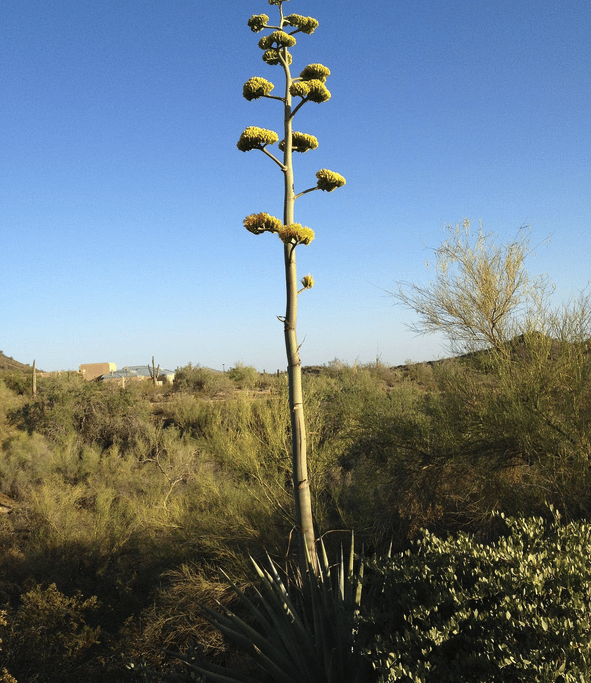
On one weekend break we took a trip up the huge mountain that loomed over town. Capillania, as it was known, rose to over 15,500 feet. There was a large rocky plain on the top of the mountain, and several remote little communities existed up there. The road up the mountain was unpaved and torturous, but busses and large trucks still shared the road with us. We rode in the back of a pick-up truck, a ubiquitous practice in the region. As we approached the top of the mountain, the terrain became as alien as another planet. The prominent plant up there was a type of century plant, but in this environment they grew immense. The central stalk would be about a foot in diameter, and thirty feet tall. The rest of the spiky leaves rose to a height of six or seven feet. The diameter of the entire plant might be ten feet. The air was dry and rather cold, even though we were pretty close to the equator. I got a touch of altitude sickness — vague nausea and lightheadedness.
We visited inside a couple of meager dwellings – wattle and daub construction with thatch roofs and dirt floors. The ceilings were probably not six feet off the ground and I had to stoop. It was hard to imagine how they subsisted up there at all. The ground was just entirely gravel. I did see some corn plants and some stunted fruit trees. I think they kept goats as well. Communication was difficult because these folks spoke an ancient Indian language that included pops and clicks and whistles. Their Spanish was about as limited as my own, but we got along just fine.
Despite their attenuated existence, these were happy and contented people, as were almost everyone we met at the bottom of the mountain as well. It was on this and another similar trip that I decided every spoiled and entitled American teenager needed to be transported to a third-world location and made to live among the people for a few weeks. It’s mighty hard to take for granted all the luxuries and labor saving devices we have after experiencing life at this level. And realizing that joy in living can just as easily be found in what we’d call deprived circumstances will really make one reassess one’s priorities.