Featured Member: Ernie Conover
Ernie Conover, who describes himself as a cabinetmaker with a woodturning problem, is a veteran woodworking author with 11 books, myriad videos, and hundreds of articles to his credit. His most recent book is the 3rd Edition of The Lathe Book, published by Taunton Press in February 2020. He served on the founding board of The American Association of Woodturners and holds Membership Number 004.
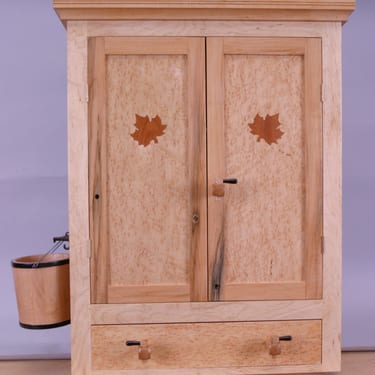
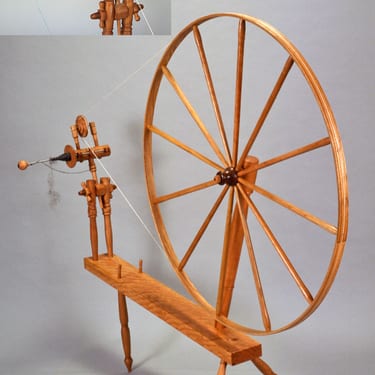
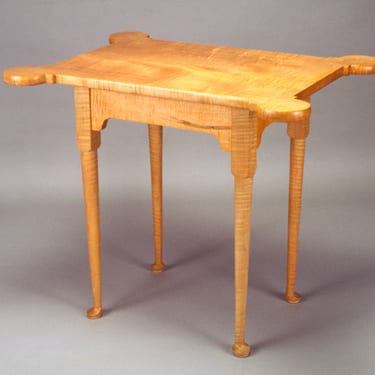
We talked with Ernie to hear more about his history within the furniture field.
Tell us a little about yourself — where you’re based and how you got started making furniture.
I grew up in a family of craftspeople; my mother was a weaver, spinner, knitter, and artist, while my father was a crackerjack machinist. I suppose I turned to woodworking so as not to compete with my father’s metalworking prowess. At that time, my dad and I were both dabbling in building weaving devices and spinning wheels. The latter required a thread-cutting tool (called a thread box) to cut a thread on a dowel. A friend urged us to make our tools commercially, and Conover Woodcraft Specialties, Inc. was the result. Besides thread boxes, we also made tools for Windsor Chair Makers that were only available in the antique market. Our most ambitious product was a woodworking lathe.
We started Conover Workshops as an offshoot of the manufacturing business to train people to use our tools. My friend Mike Dunbar taught Windsor chairmaking, and I taught woodturning and later joinery. In 1990, we sold Conover Woodcraft but kept Conover Workshops, and I went to teaching full-time. My wife, Susan runs a parallel Fiber Program to my Wood Program.
What inspires your work? Who are some of your inspirations for furniture making?
I became interested in furniture making by repairing furniture that had passed through five generations of my family. During the repair process, I marveled at the construction’s simplicity and durability and realized that was why it had lasted so long. The repairs forced me to set up a woodshop in my basement, and after repairing the furniture, I went on to make furniture. My first hand-cut dovetails were in drawers for a darkroom. (I have been a photographer and a darkroom denizen since boyhood.)
I am an autodidact, and books were my primary teachers. Tage Fried Teaches Woodworking (Still a great beginner’s textbook), Robert Wearing’s The Essential Woodworker (a must-read for every woodworker and reprinted by Lost Arts Press), and Ernest Joyce’s The Encyclopedia of Furniture Making are still go-to sources.
I count Rudy Osolnik, Steve Loar, and Leo Doyle as mentors. Rudy taught me to be a skilled woodturner and was a fellow Founding Board member of The American Association of Woodturners, as was Leo. Steve taught me to draw, and I taught him to turn. Leo became a close friend and taught me about style, work methods, finishing, and painting.
What does being a member of The Furniture Society mean to you?
I joined the Furniture Society at the urging of Garry Knox Bennett. AAW, The Furniture Society, and The Society of Period Furniture Makers all bring together like-minded people. I never fail to learn something or pick up a great idea at a meeting.
Tell us about your preferred way of connecting with clients and customers.
In the early days, we connected through trade shows and direct mail, and the school piggybacked on our manufacturing business’s advertising. We were early adopters of the internet, registering our web address in 1989. While trade shows and appearances still drive sales, our website and direct email are our primary sales channels.
Do you have a specific joinery technique, favorite tool, or favorite wood that you like? Why?
I am a huge fan of handplanes! In the past, I used antique Stanley Bedrocks (not mfg. after 1943). I now use a 4½ and 5½ Veritas Customs, in conjunction with their #62½ bevel-up and their 4½ bevel-up, with the blade ground to 38° to achieve York Pitch. This is complemented with 4 shoulder rabbet planes: two are Veritas, and two are antique bull-nosed rabbets. I also have a rare antique Stanley #72 chamfer plane that I use frequently. In a cupboard, I have an arsenal of planes which can be seen in my FS portfolio. I use two sets of Japanese chisels, which, like the Japanese, I drive with a 570-gram barrel hammer. Bringing up the rear is a wide assortment of Pfeil carving chisels and knives. Five backsaws (dovetail, tenon, carcass) hang within easy reach. For woodburning, I use a Razertip Wood Burning System with an assortment of pyrography pens. Three grinders, a buffer, a Tormek, and a variety of stones/diamond plates keep my tools sharp.
Because of my love of turning, I try to incorporate turnings in my furniture — even if it is only a knob. My signature is a contrasting dot in the center of my turned knobs; ebony, walnut, or ivory nut, depending on the knobs’ material. In the last decade, I have started graduating the knobs 1/32” larger for each bank of drawers in cabinets and increasing the size of the dots proportionally. This corrects the viewer’s downward perspective, much as entasis in a Greek column does. All in a day’s work for a cabinetmaker with a woodturning problem.
Check out Ernie’s profile page and website