“Donna Dodson: Match of the Matriarchs” Museum for Art in Wood
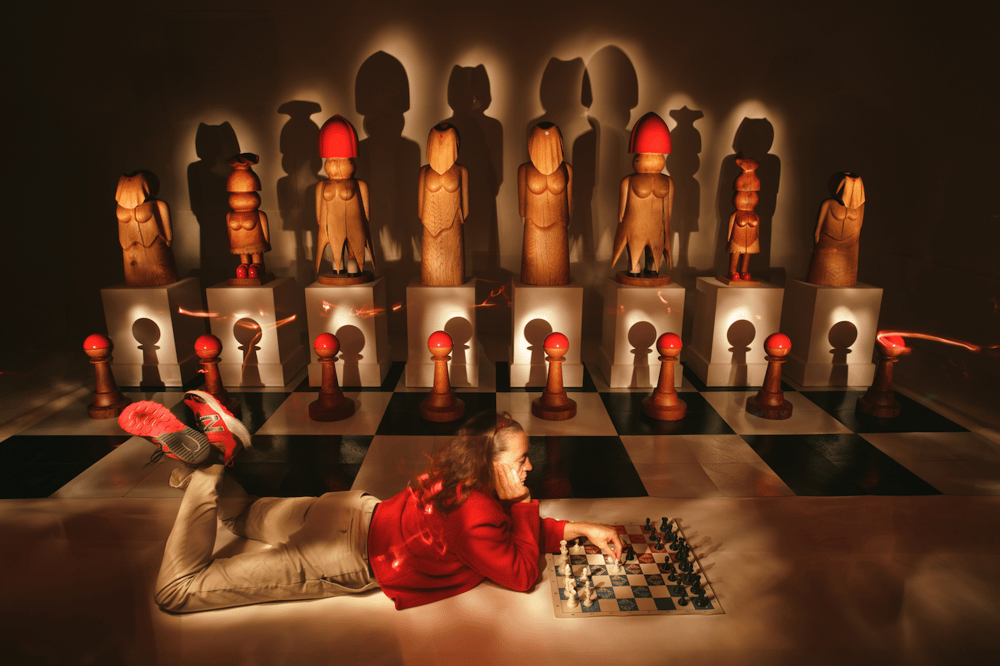
Beginning November 6, the Museum for Art in Wood (141 N. 3rd Street, Philadelphia, PA 19106) presents Donna Dodson: Match of the Matriarchs, featuring a 24-foot, chessboard comprising 32 monumental, movable pieces hand-carved from reclaimed wood. Created by Massachusetts-based sculptor Donna Dodson, the exhibition invites visitors to observe an activated chess match comprising all-female pieces modeled after feminine archetypes, mythic figures, aquatic creatures, and the powerful matriarchs in the artist’s family. Dodson’s sculptural work in wood is complemented by video and photographic works by Philadelphia-based Women’s National Chess Champion and author Jennifer Shahade. Match of the Matriarchs is on display in the Museum’s main gallery from November 6, 2026, through March 14, 2027.
Donna Dodson is an internationally recognized sculptor known for creating monumental figurative woodcarvings that challenge traditional hierarchies of power. For Match of the Matriarchs, Dodson was inspired to create a one-of-a-kind chess set, modeling the pieces after marine life and New England’s history of carved wooden figureheads on whaling vessels. Often depicting goddesses, mermaids, or captains’ wives, figurehead carvings prompted Dodson to consider how to transform mermaids from hypersexualized objects of the male gaze into a woman-sea creature hybrid, evoking the power of marine mammals. Previously exhibited at the World Chess Hall of Fame in St. Louis and the Boston Sculptors Gallery, Match of the Matriarchs evolves at the Museum for Art in Wood through new sculptures, expanded programming, and performance.
While matriarchal power and marine life shaped the figures in the exhibition’s initial presentation, Dodson continued to create new chess pieces, which will debut in the Museum for Art in Wood’s installation. Expanding on Match of the Matriarch’s exploration of binary power dynamics, Dodson drew on history, mythology, and personal connections to create figures that challenge expectations of women’s roles.
“I want my audience to consider a world filled with powerful women,” said Dodson. “An all-female chess set seems like an apt metaphor for this worldview.”
As viewers enter the Museum’s gallery, they’ll find the exhibition’s monumental chess set, with 32 chess figures comprising the game pieces. The effect takes the familiar experience of having a bird’s‑eye view of a chessboard and transforms it into an immersive one as players must move among the sculptures, presented at eye level, encountering the positions and relationships of the pieces from within the game itself. Strategy becomes a physical experience as viewers navigate an imagined struggle among chess queens, warriors, and goddesses.
Dodson fully realized her vision by adding 16 hand-carved pawns and two new Grim Reaper knights for the black side of the Matriarch’s chessboard. She also fabricated a floor-mounted chess set 10 times the size of the standard Staunton tournament set, devoted to Caissa, the goddess of chess, in which the queens are the largest pieces on the board. This set lends itself to Philadelphia chess players dropping in and playing chess variants like Double Queen chess or Caïssa Britannica (British Chess).
Positioned around the central chess match stand nine, wood-carved goddesses, each bearing her own attributes and accouterments signifying her identity and history. The nine goddesses correspond with the value of the queen, or the queen’s equal in pawns, which is also the maximum number of queens that a player can have at any one time through promoted pawns. The importance of numbers in this game of stratagem and tactical calculation is present throughout the installation.
New for the exhibition at the Museum for Art in Wood, “Goddess of Virtue Signaling” imagines an extinct Irish elk wearing a blaze orange set of antlers that signal to hunters not to shoot her. The sculpture honors the late art-world satirist Hilde Lynn Helphenstein, known as Jerry Gagosian, pairing humor with a serious reflection on humanity’s best and worst intentions. For her sculpture “The Minotaur or Beatrice Cenci for Harriet Hosmer,” Dodson reimagines Roman noblewoman Beatrice Cenci, whose resistance to her abusive father made her a tragic cultural symbol, as a powerful female minotaur holding a severed head. Paying tribute to pioneering sculptor Harriet Hosmer’s earlier depiction of Cenci, Dodson allows the black walnut’s natural beauty and partial decay to connect the material itself to the figure’s story.
Other sculptures bring the exhibition’s themes of strength, transformation, and intergenerational connection into focus through women who defied prescribed roles. In “Tomboy,” Dodson represents the legendary warrior Mulan as a muscular rabbit, drawing on the heroine’s comparison of male and female hares to question assumptions about gender. The figure’s sturdy black shoes recall those worn by Dodson’s father, linking Mulan’s service in her father’s place to the artist’s own experience as his namesake of standing in her father’s shoes. “Fight & Flight” honors Lakshmibai, the queen of Jhansi, who resisted British rule, with a sword in hand and her son secured to her back, a gesture that reminded Dodson of carrying her grandchildren. Details echoing the colors and symbols of India’s flag celebrate Lakshmibai’s legacy, bringing leadership, caregiving, and resistance together in a single figure.
Dodson’s signature use of reclaimed wood makes the material’s varied tones, grain, and scars integral to each figure. These visible traces connect the sculptures to the histories of the wood from which they were carved. Together, the figures recast chess as a setting for matriarchal power, ecological symbolism, and wisdom passed between generations, emphasizing transformation alongside the competition at the heart of the game.
Complementing Dodson’s installation are wood chess sets by other artists and works by Philadelphia-based two-time United States Women’s Chess Champion, FIDE Woman Grandmaster, author, and historian Jennifer Shahade, in collaboration with her filmmaker husband Daniel Meirom. A nationally ranked chess champion, Shahade brings a wry, incisive perspective to women’s participation and visibility in chess culture.
In response to Marilyn Yalom’s book, Birth of the Chess Queen, Shahade created an interactive chalkboard installation, “Not Particularly Beautiful,” based on the historic chessboard, “Eschequier en forme d’Eve” (or “Chess in the form of Eve”) by French author Gratien du Pont. The infamous misogynist illustration was a protest against the 16th-century changes to chess rules that made the queen the most powerful piece in the game. Outraged, du Pont drew a chessboard and penned 64 insults towards women in rhyming black and white squares that were published anonymously in 1534. He eventually was outed for the prank while the queen’s significance remained a permanent fixture in modern chess. In response to du Pont’s anti-feminist protest, Shahade created a board in which the white squares were filled with trolling comments from her social media, inviting audience participation to fill in the rest. Several variations of “Not Particularly Beautiful” have been exhibited since then, evolving into its current iteration, where viewers are encouraged to write empowering messages to girls and women instead.
The Museum presents special programming to further engage visitors around the work on display in its galleries. On November 6, from 5 to 8 p.m., visitors can attend the First Friday opening reception of Match of the Matriarchs to enjoy extended hours and meet Dodson to ask questions about her work. Visitors can also participate in a Gallery Talk on November 7, from 11 a.m. to noon, where Dodson will share insights into her artistic practice and work on display in the exhibition. On November 13, from 6 to 8 p.m., the Museum hosts chess champion and author Jennifer Shahade for a Game Night and Book Signing, featuring her book Thinking Sideways, inviting visitors to explore the exhibition’s connections to chess and creative thinking.
Beyond Match of the Matriarchs, Dodson has participated in numerous residencies and been exhibited around the world. A graduate of Wellesley College, she has completed successful residencies in Verbier, Switzerland, Cusco, Peru, Keelung, Taiwan, and Denmark. Dodson is currently a Scholar at the Brandeis University Women’s Studies Research Center and a former Visual Art Fellow at the St. Botolph Club in Boston. She was a 2022 Fulbright US Scholar at Q21/MuseumsQuartier in Vienna, Austria, working as an artist-in-residence with her host institution Tricky Women/Tricky Realities, the world’s only animation festival for women. Dodson has won grants from the Puffin Foundation, Massachusetts Cultural Council, the New Hampshire Guild of Woodworkers, and the George Sugarman Foundation. Her work is in the permanent collection of the World Chess Hall of Fame in St. Louis, Missouri, the Provincetown Art Museum, the Art Complex Museum, and the Fuller Craft Museum in Massachusetts, the Noyes Art Museum in New Jersey, and the Davistown Museum in Maine. Donna’s work has been reviewed in the Boston Globe, Sculpture Magazine, The Daily Beast, Hyperallergic, and Artnet. Dodson is