Featured Member: Hugo Nakashima-Brown
Hugo Nakashima-Brown is a teaching artist, designer, and woodworker with a background in painting and furniture making. He holds a BFA in Painting from the Rhode Island School of Design and a Professional Degree in Cabinet and Furniture Making from the North Bennet Street School. His multidisciplinary experience spans woodworking, design, curation and production studio management, allowing him to blend diverse perspectives into his craft. Trained as a 17 – 19th century woodworker, Nakashima-Brown draws on historical precedents and centuries of craftsmanship to create furniture that balances timeless aesthetics with the functional needs of the 21st century. Inspired by the Japanese tea ceremony (chanoyu), where design, function and aesthetics converge, he uses chanoyu and Japanese/American folk art as frameworks to explore the intersection of art, craft, sculpture and performance/installation. His current research examines the overlooked, bidirectional influence between Chinese and American furniture traditions.
Nakashima-Brown’s work has been exhibited nationally and internationally and has been featured in Monocle, Architectural Digest, the Magazine Antiques, and Fine Woodworking. He has received support from institutions including RISD, Penland, Winterthur Museum, the Center for Furniture Craftsmanship, Oak Spring Garden Foundation, Harvard University’s Ed Portal, and Arrowmont School of Arts and Crafts.
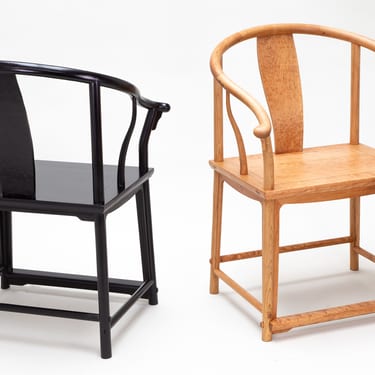
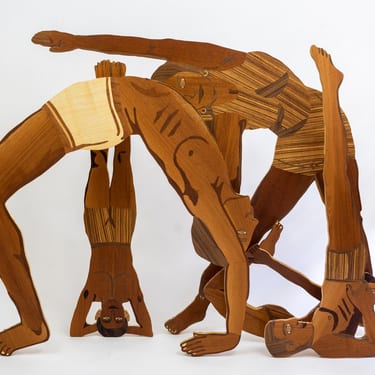
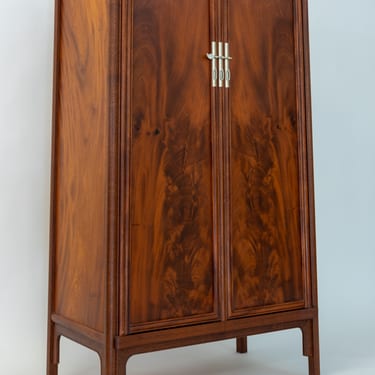
We caught up with Hugo to hear more about his background and interests within the furniture field.
Tell us a little about yourself — where you’re based and how you got started making furniture.
I’m currently based between Detroit and Boston, teaching and making work in my studio. I got into woodworking almost by accident. I had been living in South Korea during COVID and on my way back to the States, relatives with a long-standing furniture business offered me a design job. I had always been drawn to wood, though my only real experience was making canvas stretchers. From day one, I loved designing around wood. It combined my interest in architecture with the ability to work directly and intimately with material. After two years, I left the family business to start my own practice and enrolled at North Bennet Street School in Boston to study period furniture making.
What inspires your work? And who are some of your inspirations for furniture making?
I have long been curious about primary sources in design history and about the ambiguities that emerge when historical forms and techniques are interpreted across cultures and periods. I tend to work these ambiguities into my own forms, so at first glance my interests can sometimes seem contradictory. My work moves between meticulous, interlocking joinery and contemporary reinterpretations of Ming and “Queen Anne” furniture.
Much of my past work has been rooted in the Ming furniture tradition, which remains a strong interest, although increasingly I’m more interested pedagogically: in making its techniques better documented and more accessible to the next generation of students.
What does being a member of the furniture community, and specifically The Furniture Society, mean to you?
When I was starting out on my own, I had a lot of help along the way, especially from Andrew Hunter, who I want to take this opportunity to thank — for taking a few days out of his life to show me the ropes of sharpening and tuning a Japanese hand plane — as well as Suz Walton and Michael Puryear for their generosity at the same time. I think that in such a generous and tight-knit community, we have a responsibility to help the next generation in the same way we were helped when we were starting out. I try to do that formally through my teaching, but also informally whenever I can, and especially through venues like the Furniture Society.
Tell us about your preferred way of connecting with clients and customers. Do you sell online, attend shows, fairs, or markets, or primarily accept custom work?
If it were up to me, I would make whatever I wanted, whenever I wanted, and simply follow my curiosity. I’m a workaholic, so I’m fortunate that teaching provides enough of my income to leave room for that kind of freedom in the studio.
Most of my clients and customers have found me through other opportunities I’ve pursued, either encountering my work online or seeing it in person and subsequently looking me up. Because I work alone in my studio, I don’t generally produce work on spec (nowhere to store it). I primarily make pieces for specific exhibitions, on commission for clients, or as research and development in the studio without a particular venue in mind.
Do you have a specific joinery technique, favorite tool, or favorite wood that you like to use? Why is it your favorite?
I love Japanese Elm (keiyaki), but is hard to find a reliable source of it here, even though it is often grown ornamentally. My favorite tool is a spoke shave I made out of an old bandsaw blade and piece of scrap wood, it just works really well for shaping and leaves a glassy surface. Favorite joinery technique? Maybe a tapered sliding dovetail, it is just so versatile.
Check out Hugo’s profile page, website, and social media.